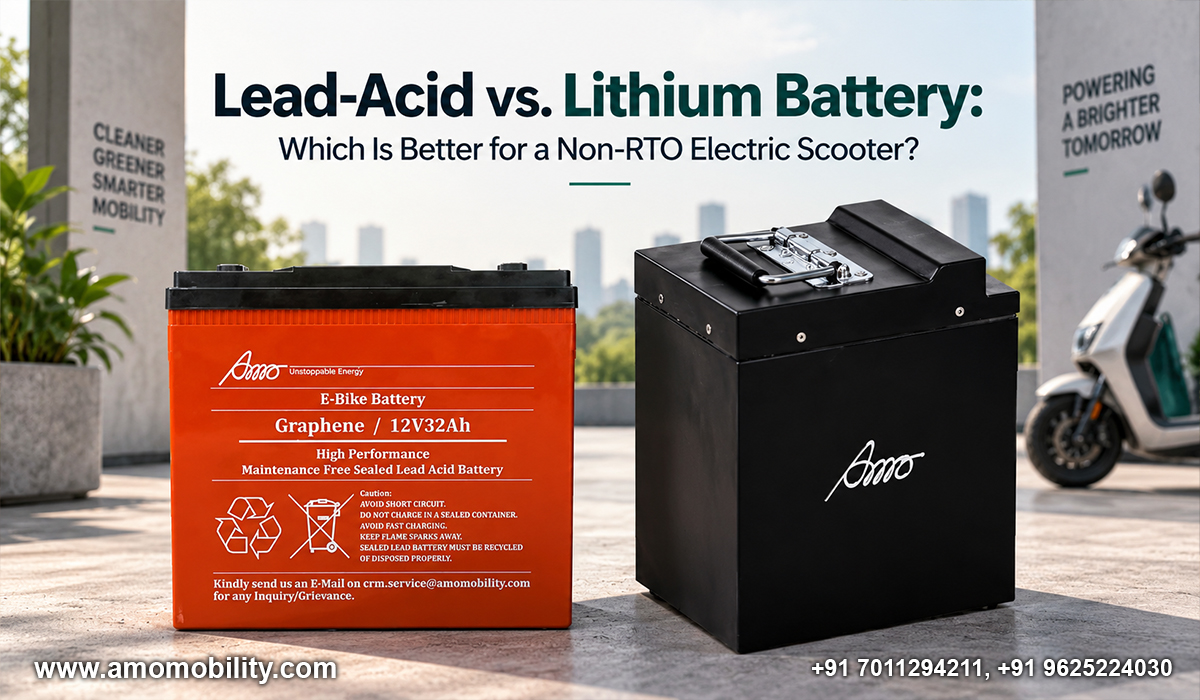
When buying an AMO electric scooter, the battery is one of the most important factors to consider. It directly affects the scooter's range, charging time, weight, performance, and overall ownership cost. For non-RTO electric scooters, buyers typically see two battery options: lead-acid and lithium-ion.
Both technologies have their own advantages. Lead-acid batteries can offer a lower initial purchase cost, while lithium-ion batteries are generally lighter, more efficient, and convenient for regular use. Understanding the difference can help you choose an electric scooter according to your daily travel requirements and budget.

The biggest advantage of a lead-acid battery is its lower upfront cost. This makes it suitable for buyers searching for a cheap electric scooter for short-distance travel.
However, lead-acid batteries are heavier than lithium-ion batteries and generally take longer to charge. Their weight can also influence the overall handling and efficiency of the scooter.
For someone who travels limited distances every day and usually charges the scooter overnight, a lead-acid battery can still be a practical option.

For riders who use their scooter frequently, a lithium-ion battery can be attractive because the lower battery weight can contribute to easier handling and efficient performance.
AMO Mobility offers several scooter models with lithium-ion and lead-acid battery options. For example, the AMO product range currently lists models such as the Jaunty S, Single Light, Brisk, Feisty EV, Jaunty L, and Jaunty with both lithium and lead-acid variants, depending on the model.
| Feature | Lead-Acid Battery | Lithium-Ion Battery |
| Initial cost | Generally lower | Generally higher |
| Weight | Heavier | Lighter |
| Charging | Usually slower | Usually faster |
| Maintenance | Low to moderate | Generally low |
| Range potential | Generally lower | Generally higher |
| Long-term use | Suitable for light usage | Suitable for frequent usage |
| Best suited for | Budget-focused riders | Regular commuters |
These differences can make a noticeable difference in everyday riding. AMO's own battery comparison similarly notes that lithium-ion batteries are lightweight and generally faster to charge, while lead-acid batteries have a lower initial cost.
Range depends on several factors, including battery capacity, motor efficiency, rider weight, road conditions, riding style, tyre pressure, and temperature. Therefore, battery chemistry alone does not determine the actual range of an electric scooter.
In general, lithium-ion batteries have higher energy density, allowing more energy to be stored without adding as much weight. This is one reason they are commonly associated with long-range electric scooter models.
However, buyers should always check the manufacturer's claimed range and understand that real-world range can vary from the advertised figure.
Charging time is another important difference.
Lithium-ion batteries generally charge faster charging than conventional lead-acid batteries. This can be useful for riders who use their scooter multiple times during the day.
Lead-acid batteries can take longer to charge, but this may not be a major issue for users who travel short distances and charge their scooter overnight.
AMO's Jaunty information, for example, lists charging options for both lithium-ion and VRLA battery variants, with charging time and range depending on the selected configuration.
If your priority is the lowest initial purchase price, lead-acid can be an attractive choice. The battery technology generally costs less upfront, which can help keep the price of an entry-level AMO electric scooter lower.
Lithium-ion batteries usually require a higher initial investment. However, buyers should look beyond the purchase price and consider battery life, charging convenience, weight, and expected usage.
Therefore, the cheapest option at the time of purchase is not necessarily the lowest-cost option over the entire ownership period.
The answer depends on how you plan to use the scooter.
A lead-acid battery can make sense if you:
i) Have a limited purchase budget.
ii) Mostly travel short distances.
iii) Use your scooter occasionally.
iv) Prefer a lower initial cost.
v) Normally charges overnight
A lithium-ion battery can be more suitable if you:
i) Ride your scooter regularly.
ii) Want a lighter vehicle.
iii) Prefer convenient charging
iv) Need good range for daily travel.
v) Plan to keep the scooter for several years.
This does not mean that one battery is universally suitable for every rider. Your daily distance, charging availability, budget, and expected ownership period should all be considered.
AMO Mobility provides different electric scooter configurations, including models available with lithium-ion and lead-acid battery options. This gives buyers flexibility to select a configuration according to their requirements.
For example, buyers looking for an affordable scooter for short urban trips may consider a lead-acid variant, while frequent commuters may prefer the lighter and more convenient characteristics of a lithium-ion option.
Before choosing a model, check the battery capacity, claimed range, charging time, warranty, service support, and replacement cost rather than looking only at the electric scooter price.
Lead-acid and lithium-ion batteries can both be suitable for a non-RTO electric scooter, but they serve different priorities.
Lead-acid technology can be useful for budget-conscious riders who mainly make short trips. Lithium-ion technology generally offers advantages in weight, charging convenience, energy density, and long-term everyday usability.
If you are planning to buy an electric scooter for regular commuting, compare the complete package rather than focusing only on the battery type. Look at range, charging time, battery warranty, service availability, running requirements, and your daily riding distance.
Whether you are searching for an AMO electric scooter, a long-range electric scooter, or an affordable electric scooter, choosing the battery according to your actual usage can make your ownership experience more practical and cost-effective.
© AMO Mobility Solutions Pvt. Ltd, All Rights Reserved | Powered by Amo Electric Bikes